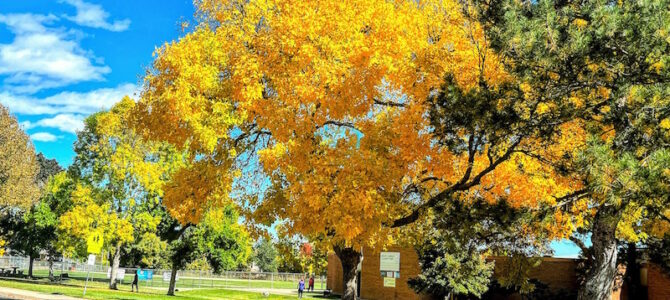
How Trees Prepare for the “Big Chill”
___
On Friday November 7 we will be coordinating a volunteer effort with Denver Christian School, raking leaves for our elderly and disabled neighbors. Our neighborhood volunteers will take the bagged leaves to Fleischer Family Farm, right here in the neighborhood, to be used as mulch and compost. We have two questions for you:
- Can you help unload bagged leaves from our pickup trucks at the Farm? November 7 starting at or after 11:00. Check the details and SIGN UP HERE to be a Bag Wrangler. (If you can’t add your name, email us at sgna.lakewood@gmail.com to volunteer.)
- How do those trees come up with those beautiful FALL COLORS? It’s science! Read on!
By Joe Woelkers
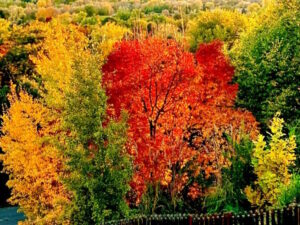 Fall brings not only the excitement of Halloween and NFL games but the “fun” of collecting and disposing of leaves (at least jumping in them is fun). Why do the leaves fall off every year anyway? Leaves change color and fall off trees mostly because trees are reacting to less sunlight and cooler temperatures as seasons change. During spring and summer, trees use their leaves to collect sunlight and make food through photosynthesis. The green color in leaves comes from chlorophyll, a pigment that absorbs sunlight and helps create energy for the tree.
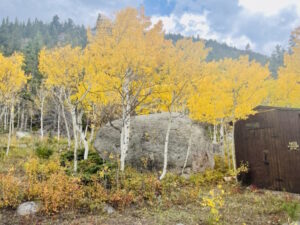 When autumn comes, the days get shorter and cooler. Trees sense these changes and start to slow down chlorophyll production. As the green fades away, other pigments inside the leaf start to show. These pigments are called “carotenoids” which were always in the leaf, and they give leaves yellow and orange colors. While aspens are commonly seen as yellow, and if lucky, orange, aspens can turn red as well. Following periods of cold, near-freezing nights, more sugar will accumulate in the leaves because the veins in the leaves will close down to protect the tree. This collection of sugar in the leaf leads to the development of “anthocyanin,” which makes leaves look red or purple.
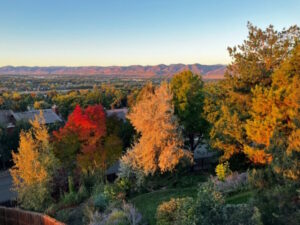 Trees are preparing for winter when water is scarce, and keeping leaves would waste valuable resources. Trees form a special layer called the abscission layer at the base of each leaf stem. This layer blocks water and nutrients from traveling into the leaf, eventually making it break off and fall. As the tree moves into winter, all new tissue growth ceases and the tree enters a hibernation-like state.
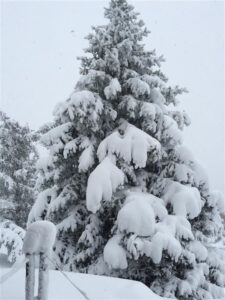
Evergreen, except sometimes white.
In contrast, evergreens or coniferous trees such as pines and spruce do not lose their needles. This is because they are specially adapted to winter climates. These adaptations include: closing their “stomata,” or tiny pores in their needles to reduce water loss, containing resins and chemicals that act as antifreeze in the needles, and an increase of unsaturated fatty acid which lowers the freezing point of pine cells boosting cold resistance. Deciduous and coniferous trees follow different paths into winter, but each underscores nature’s capacity to adapt.

Subscribe to get an email notice when our weekly articles are published.